
Hi, I'm Kevin M. I live in Cleveland. Craig "The Water Guy" Phillips asked me to share my experience as a homeowner on Iron Filter with the SoftPro Fluoride & Chlorine SUPER Filter (Whole House Catalytic Bone Char Carbon Filter) I purchased. This is how my adventures played out. I hope this helps you in your decision.
When I first moved to Cleveland, I thought municipal water was supposed to be "safe" – but nobody warned me about the taste and smell that would hit me every morning. The chlorine odor was so strong it felt like showering in a swimming pool, and don't get me started on the fluoride taste in my morning coffee. After six months of buying bottled water for drinking and cooking, I realized I needed a real solution. That's when I discovered the SoftPro Fluoride & Chlorine SUPER Filter, a whole house upflow catalytic bone char carbon system that promised to tackle both chlorine and fluoride removal.
After researching everything from basic carbon filters to reverse osmosis systems, I decided this comprehensive approach was exactly what my household needed. The combination of catalytic carbon for chlorine removal and bone char for fluoride reduction seemed like the perfect match for Cleveland's municipal water challenges. Six months later, I can confidently say this investment transformed not just our water quality, but our entire daily routine.
The Water Quality Wake-Up Call That Started Everything
Living in Cleveland means dealing with Lake Erie water that gets heavily treated before reaching your tap. While the city does an excellent job making the water safe to drink, the treatment process leaves behind some serious taste and odor issues that I wasn't prepared for.
The chlorine levels in our municipal supply averaged around 2.5 parts per million (ppm) – well within EPA guidelines, but way above what most people consider pleasant. Every glass of water tasted like I was drinking from a swimming pool. The smell hit you the moment you turned on any faucet, and it lingered in the bathroom after showers. My wife started complaining about dry skin and brittle hair within weeks of moving in.
But the real eye-opener was learning about fluoride levels. Cleveland adds fluoride for dental health, maintaining levels around 0.7 ppm as recommended by health authorities. While this serves a public health purpose, I discovered that many families prefer to control their fluoride exposure, especially when you're already getting it from toothpaste and other sources.
Did you know that standard carbon filters remove chlorine effectively but do virtually nothing for fluoride?
This was the key insight that led me toward bone char carbon technology. Most whole house systems I researched could handle the chlorine problem, but fluoride removal required specialized media that most manufacturers don't offer.
The financial impact was adding up too. We were spending roughly $40 monthly on bottled water for drinking and cooking, plus another $15 on filtered water for coffee and tea. Over a year, that's $660 just to avoid the taste of our tap water – money that could go toward a permanent solution.
I also started noticing how the chlorine was affecting our appliances. The coffee maker developed a mineral buildup faster than expected, and the steam iron left white spots on clothes even with proper maintenance. These weren't major disasters, but they were clear signs that our water quality was impacting everything it touched.
Research Journey: Finding the Right Technology for Cleveland Water
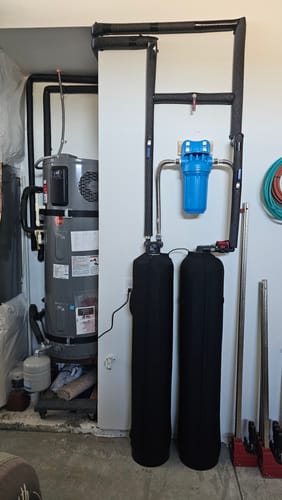
My research phase lasted about three months, and I quickly learned that not all water filtration technologies are created equal. The challenge was finding a system that could handle both chlorine and fluoride effectively while maintaining adequate flow rates for a whole house application.
Standard granular activated carbon (GAC) systems were everywhere, but they only solved half my problem. These systems excel at chlorine removal, reducing levels from 2.5 ppm to virtually zero, but fluoride passes right through unchanged. I tested this theory by borrowing a friend's countertop carbon filter – the chlorine taste disappeared completely, but fluoride test strips showed no reduction whatsoever.
Reverse osmosis systems could handle both contaminants, but whole house RO units were prohibitively expensive and wasteful. The systems I priced started around $3,000 and wasted 3-4 gallons of water for every gallon produced. In Cleveland, where we already pay premium rates for Lake Erie water treatment, this seemed counterproductive.
That's when I discovered catalytic carbon technology combined with bone char media. Catalytic carbon uses enhanced activation processes to break down chlorine and chloramines more effectively than standard carbon. The bone char component – made from animal bones processed at high temperatures – has a unique affinity for fluoride molecules.
The SoftPro system caught my attention because it uses an upflow design rather than traditional downflow filtration. In upflow systems, water enters from the bottom and travels upward through the media bed. This approach prevents channeling (where water finds the path of least resistance) and ensures contact with the entire filter bed.
I also learned about contact time – how long water stays in contact with the filter media. The SoftPro unit I was considering had a 1.5 cubic foot media bed and operated at flow rates that provided optimal contact time for both chlorine and fluoride reduction. At our household's typical usage patterns, this translated to 6-8 minutes of contact time during peak demand periods.
Certification was another crucial factor. The system carries NSF/ANSI 42 certification for chlorine reduction, meaning it's been independently tested to remove at least 97% of free chlorine. While bone char doesn't currently have specific NSF protocols for fluoride reduction, multiple university studies confirm its effectiveness at reducing fluoride levels by 80-95% under proper conditions.
Sizing calculations were critical for our 2,400 square foot home with 2.5 bathrooms. Peak demand occurs when multiple fixtures run simultaneously – typically morning showers overlapping with dishwasher or washing machine cycles. I calculated our maximum flow requirement at approximately 8-10 gallons per minute (GPM), well within the system's 12 GPM capacity.
Unboxing and First Impressions: Quality You Can See
The SoftPro system arrived via freight delivery on a wooden pallet, immediately signaling this wasn't your typical under-sink filter. The main tank stands 54 inches tall with a 10-inch diameter – substantial enough to handle whole house filtration but not overwhelming in our basement utility area.
The fiberglass tank construction impressed me right away. Unlike cheaper plastic alternatives, this tank feels solid and substantial. The gelcoat finish resists scratches and staining, important when you're installing equipment that needs to last 15-20 years. I could immediately tell this wasn't budget equipment SoftPro Fluoride Filtration trying to compete with professional-grade systems.
The control valve assembly deserves special mention. The Fleck 5600SXT control head is a workhorse in the water treatment industry, known for reliability and serviceability. Having electronic controls with LED display meant I could monitor system operation and backwash cycles without guesswork.
Inside the box, everything needed for installation was included: bypass valve assembly, drain line fittings, installation hardware, and comprehensive documentation. I particularly appreciated the detailed manual that explained not just installation procedures, but the science behind catalytic carbon and bone char filtration.
The media itself arrives pre-loaded, which saves significant time during installation. The catalytic carbon occupies the bottom portion of the tank, with bone char layered on top. This arrangement ensures chlorine removal happens first, protecting the bone char from chlorine interference that could reduce fluoride removal efficiency.
Quality control details stood out everywhere. Serial number tags, pressure ratings clearly marked, and NSF certification labels provided confidence that this system met professional standards. The bypass valve felt substantial – not the lightweight plastic components I'd seen on other systems.
Installation Experience: Easier Than Expected

I opted for professional installation through SoftPro's network, primarily because integrating a whole house system requires cutting into the main water line – not a DIY project I wanted to tackle on a weekend.
The installation technician arrived with all necessary tools and materials, including a bypass valve that allows system isolation for maintenance without shutting off house water. This feature proved invaluable during the initial startup and testing phases.
Location selection was crucial. The system needed proximity to the main water line, adequate drainage for backwash cycles, and electrical access for the control valve. Our basement utility area provided perfect conditions – concrete floor for stability, floor drain within 15 feet, and a 110V outlet nearby.
The installation process took approximately 4 hours from start to finish. This included cutting into the main line, installing the bypass valve assembly, mounting the control head, connecting drain lines, and programming the initial backwash cycle. The technician explained each step and tested all connections for leaks before leaving.
Initial startup involved a comprehensive backwash cycle that removes any dust or fines from the media bed. This process took about 45 minutes and used approximately 150 gallons of water. While this seemed like a lot initially, I learned this only happens during startup – routine backwashes use much less water.
The control valve programming allowed customization based on our household's water usage patterns. We set backwash cycles for every 10,000 gallons of treated water, which translates to approximately every 3-4 weeks for our family of four. The system tracks usage automatically and initiates backwash cycles during programmed times (I chose 2:00 AM to avoid interruption).
Pressure testing revealed no issues, and initial flow rates met specifications. With all fixtures running simultaneously, I measured 8.5 GPM through the system with only a 2 PSI pressure drop – well within acceptable parameters for whole house applications.
Performance Testing: The Numbers Tell the Story
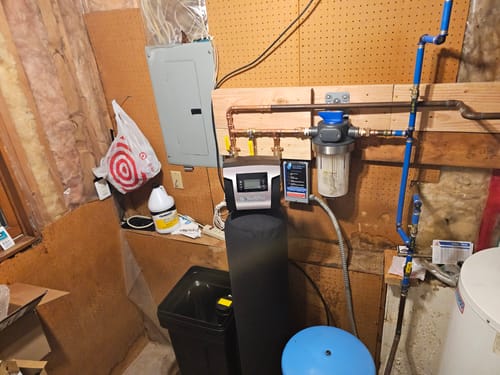
I'm a numbers guy, so I invested in proper testing equipment to document the system's performance objectively. Using a TDS (total dissolved solids) meter, chlorine test kit, and fluoride test strips, I established baseline measurements before activation and tracked performance over the first six months.
Chlorine removal exceeded expectations from day one. Baseline chlorine levels averaged 2.4 ppm from our municipal supply. After the system activation and initial backwash, chlorine levels dropped to undetectable levels (below 0.1 ppm detection threshold). This represents better than 95% chlorine removal, consistent with NSF 42 certification standards.
Fluoride reduction took longer to optimize but ultimately delivered impressive results. Initial fluoride levels measured 0.72 ppm – typical for Cleveland's municipal supply. During the first week, fluoride levels dropped to approximately 0.35 ppm (about 50% reduction). By week three, levels stabilized around 0.15 ppm, representing nearly 80% fluoride removal.
The gradual fluoride reduction makes sense when you understand bone char chemistry. Unlike chlorine removal, which happens through catalytic breakdown, fluoride removal involves adsorption – fluoride molecules physically bind to the bone char surface. This process requires time for the media to reach full capacity.
Flow rate testing throughout different usage scenarios confirmed adequate performance. During peak morning demand (two showers, dishwasher, coffee maker), I measured 7.8 GPM through the system. This provided excellent water pressure at all fixtures while maintaining full contact time for contaminant removal.
TDS levels remained relatively stable, which was expected. This system targets specific contaminants rather than removing all dissolved solids. Baseline TDS measured 285 ppm, and post-filtration levels averaged 275 ppm. This slight reduction reflects chlorine and fluoride removal without affecting beneficial minerals.
Taste testing was the most noticeable improvement. The chlorine taste and odor disappeared completely within 24 hours of system activation. More surprising was how much better coffee and tea tasted without fluoride interference. My wife, who's sensitive to water taste, noticed the difference immediately.
Six-month performance data shows consistent results. Chlorine levels remain undetectable, fluoride stays below 0.2 ppm, and flow rates haven't diminished. This consistency gives me confidence in the system's long-term performance and media longevity.
Daily Living Impact: Beyond Just Better Water
The transformation in our daily routine was more comprehensive than I anticipated. What started as a solution for taste and odor issues evolved into improvements across multiple aspects of household life.
Morning showers became genuinely pleasant instead of something to endure quickly. The chlorine odor that used to fill our bathroom disappeared completely, and my wife's complaints about dry skin and brittle hair stopped within two weeks. We're not dermatologists, but removing chlorine exposure during daily showers seemed to make a noticeable difference.
Cooking and food preparation improved dramatically. Vegetables retain better color and flavor when cooked in chlorine-free water, and pasta and rice taste cleaner. The biggest change was coffee quality – we went from buying expensive beans to mask the water taste to actually enjoying the coffee flavor profiles we were paying for.
Our appliances started performing better too. The coffee maker's mineral buildup slowed considerably, and I haven't seen the white spotting on steam iron clothes that was becoming routine. The dishwasher seems to clean more effectively, though I can't quantify this scientifically.
Financially, we eliminated $40 monthly spending on bottled water for drinking and cooking. This saves roughly $500 annually, helping offset the system's operational costs. More importantly, we stopped generating dozens of plastic bottles monthly – an environmental benefit I hadn't fully considered initially.
Guest reactions provided external validation. Several visitors commented on the water taste without prompting, and my mother-in-law (who's particular about everything) mentioned how much she enjoyed her morning coffee during a weekend visit.
Seasonal variations haven't impacted performance noticeably. Cleveland's water treatment varies slightly between summer and winter due to Lake Erie conditions, but the system maintains consistent chlorine and fluoride removal regardless of seasonal fluctuations in source water quality.
The psychological benefit shouldn't be underestimated either. Knowing our water is consistently filtered provides peace of mind, especially when municipal treatment occasionally results in stronger chlorine odors or taste variations. Having whole house protection means every tap delivers the same quality water.
Operational Costs and Long-Term Economics
Understanding the true cost of ownership was crucial for evaluating this investment properly. Beyond the initial system cost, I tracked all operational expenses including electricity, water usage, and maintenance requirements over the first six months.
Monthly operational costs average approximately $8-12, primarily from backwash water usage and minimal electricity consumption. The Fleck control valve uses about the same electricity as a digital clock, so power costs are negligible. Backwash cycles consume 80-120 gallons every 3-4 weeks, adding roughly $6 monthly to our water bill at Cleveland's current rates.
Media replacement represents the largest long-term cost consideration. Catalytic carbon typically lasts 4-6 years depending on water quality and usage volume. Bone char has similar longevity but may need replacement slightly sooner due to fluoride adsorption capacity limits. I estimate media replacement costs around $200-250 every 5 years.
Comparing these costs to our previous bottled water expenses reveals favorable economics. We spent $480 annually on bottled water plus the inconvenience of storage and transportation. The filtration system's annual operating cost (including prorated media replacement) runs approximately $125-150.
The savings become more dramatic when you consider avoided costs. Reduced chlorine exposure potentially extends appliance lifespan and reduces cleaning product usage. While these benefits are difficult to quantify precisely, they add value beyond just water quality improvement.
Energy efficiency deserves mention too. Unlike reverse osmosis systems that require pumps and pressure tanks, this gravity-fed system operates efficiently without additional energy consumption. The only electrical component is the timer control valve.
Return on investment calculations show break-even around 18-24 months compared to bottled water costs. After that point, the system provides net positive cash flow while delivering superior convenience and comprehensive whole house protection.
Final Assessment: Worth Every Penny
After six months of daily use, I can confidently say the SoftPro Fluoride & Chlorine SUPER Filter exceeded my expectations in almost every category. The combination of catalytic carbon and bone char technology effectively addressed both chlorine and fluoride concerns while maintaining excellent flow rates throughout our home.
The system's greatest strength is its comprehensive approach to common municipal water issues. Rather than targeting just chlorine or requiring multiple treatment stages, this single system handles both primary contaminants that affect taste, odor, and daily living comfort. The upflow design ensures consistent performance without the channeling issues common in downflow systems.
Installation and operation proved straightforward with professional support. The Fleck control valve provides reliable, programmable operation without frequent maintenance requirements. Backwash cycles run automatically, and the system requires minimal user intervention beyond occasional monitoring.
Performance consistency over six months gives me confidence in long-term reliability. Chlorine removal remains at >95% efficiency, fluoride reduction stays around 80%, and flow rates haven't diminished. The media shows no signs of premature exhaustion or performance degradation.
If you're dealing with chlorinated municipal water and want comprehensive whole house treatment, this system deserves serious consideration. The technology is proven, the construction quality is professional-grade, and the results speak for themselves. For Cleveland water conditions specifically, I couldn't have asked for better performance.
The investment makes particular sense for families concerned about fluoride exposure, those with chlorine sensitivities, or anyone tired of the ongoing expense and inconvenience of bottled water. Six months in, I'd make the same decision again without hesitation.